HOW WE WORK

Shared cognition, grounded in evidence.

FutCo works from a shared-cognition ledger: an evidence-linked record of the relevant inputs, model contributions, disagreements, decisions, and outcomes behind the work. Multiple models help challenge assumptions, while people remain responsible for judgment and decisions. Every recommendation in an Audit or Sprint comes from practices and tooling used daily to run FutCo and E3D — not slideware.

THE SHARED-COGNITION WORKFLOW

A durable record from evidence to outcome.

The workflow keeps context, competing views, human decisions, and results connected. Governance, review, and approval controls support the process; models contribute perspectives and evidence, but people remain accountable for judgment and decisions.

  1. 01

    Retain — shared-cognition ledger

    LIVE

    Durable working context

    • Relevant inputs, notes, context, and handoffs stay available to later work
    • Model contributions, disagreements, decisions, and outcomes remain linked to the record
    • Source references make important claims reviewable instead of relying on model memory alone
  2. 02

    Challenge — multi-model debate

    Evidence-linked perspectives

    • Models make claims, test assumptions, and offer competing interpretations
    • Claims and disagreements stay connected to supporting or contradicting evidence
    • People can review the debate; the process does not manufacture automatic consensus
  3. 03

    Record — decisions and outcomes

    LIVE

    Human accountability and learning

    • People apply judgment, make consequential decisions, and approve delegated action
    • The decision, rationale, action, and observed outcome become part of the ledger
    • Later work can recover the evidence and context that mattered at the time
  4. 04

    Trace — emerging provenance graph

    EXPERIMENTAL

    Evaluated, read-only, and incomplete

    • Relationships derived from ledger records can show how sources, claims, decisions, actions, and outcomes connect
    • We have evaluated this graph-shaped view as a way to inspect provenance and recover context
    • It remains an emerging, read-only view of available records — not a complete or production-proven account of every influence

BEYOND E3D

This isn't a crypto-only pattern.

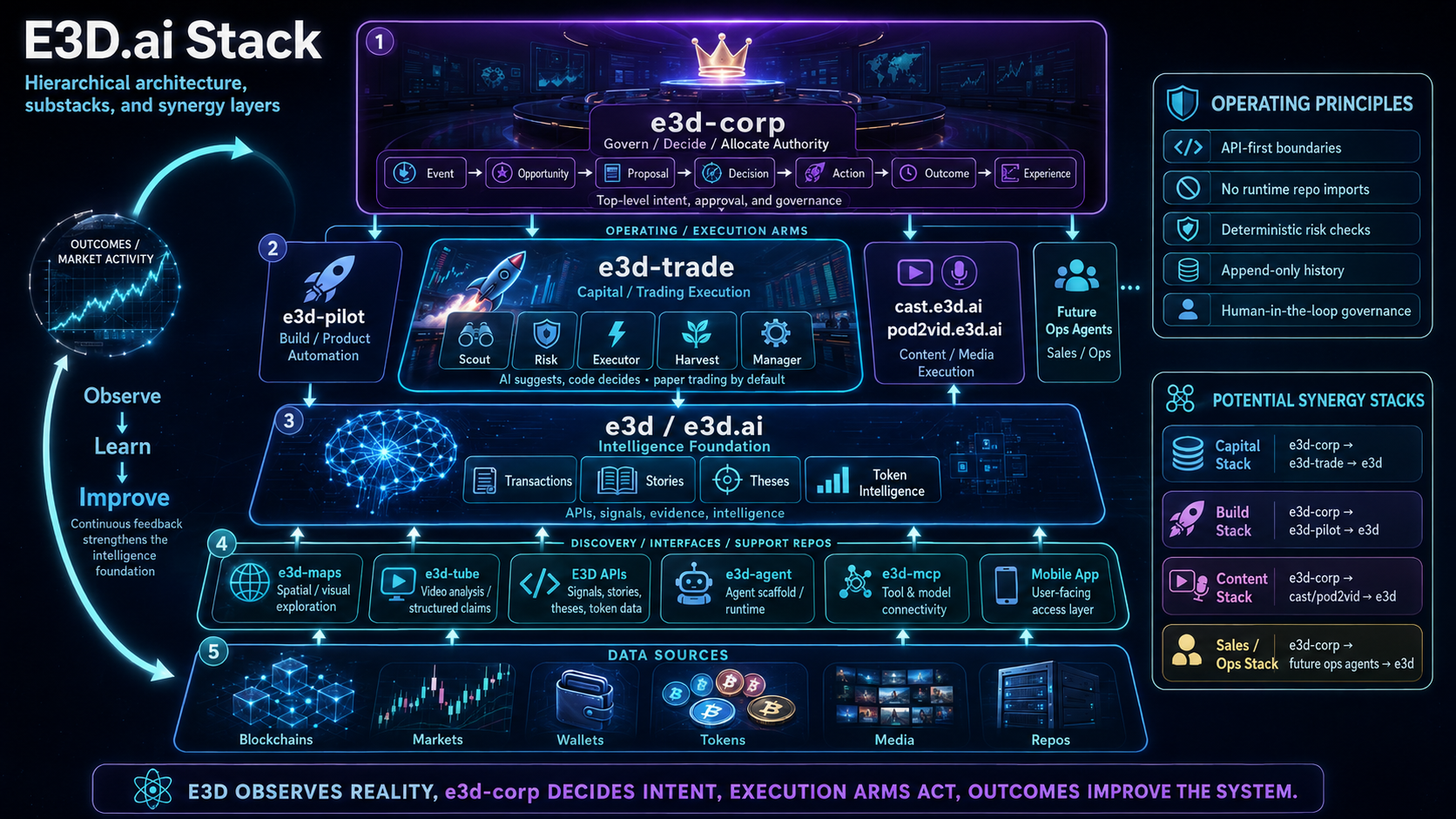
The shared-cognition workflow can span several company systems: e3d-corp records governed opportunities and decisions, specialized systems execute approved work in capital, build, and content, and E3D supplies domain evidence. The ledger keeps their context and handoffs connected without treating any model or system as the sole source of truth.

For a client, the relevant evidence may come from CRM, documents, email, ERP, transaction history, support tickets, and internal knowledge. The pattern is the same: retain useful context, challenge interpretations against evidence, keep people accountable for decisions, and record outcomes so later work can learn from what happened.

CURRENT EXPERIMENT

Does governance improve autonomous trading?

  • PAPERe3d-trade — two isolated paper books running side by side
  • EXPERIMENTALe3d-corp → e3d-trade governance link — connected, mandate active

e3d-trade already ran continuously against live E3D signals in paper mode on its own judgment — five agents propose, deterministic code enforces every risk limit, real order submission stays off. That's still true. What's new: e3d-corp can now turn live E3D evidence into an investing Opportunity, draft a capital_mandate Proposal, require a human decision, and hand the approved mandate to e3d-trade — tagged and traceable end to end back through the same event log. We've stood up two identical paper books trading the same live signals over a predeclared window against a BTC-hold benchmark: one operates under an active governance mandate, the other doesn't. That comparison is running now, on simulated capital.

The rule was fixed before the link went live: e3d-trade exercises only the authority e3d-corp delegates to it, and a mandate can only tighten e3d-trade's own risk limits, never loosen them. We're not assuming governance improves autonomous systems. We're measuring whether it does — on paper capital, against a predeclared benchmark, before this touches anything real.

THE MACHINERY UNDERNEATH IT

The machinery underneath it.

These models, context services, build tools, and interfaces support the shared-cognition workflow and the company systems that act on approved work.

Models

Models are interchangeable compute, chosen for capability, privacy, latency, and cost — not brand loyalty.

  • Claude, Codex, Grok, and Devin — accessed through flat-rate CLI subscriptions instead of pay-per-token API billing
  • A fine-tuned Qwen model running locally for jobs that don't need a frontier model or a third partyLIVE

Context

  • e3d-mcp — E3D's live blockchain analytics and agent data, exposed as MCP toolsLIVEView on GitHub ↗
  • futco-mcp — repo ecosystem knowledge for every coding session (private — it indexes internal systems)LIVE

Build

  • codex-spec-runner — phase-by-phase, spec-driven implementation against Codex or ClaudeLIVEView on GitHub ↗
  • e3d-pilot — agentic loops that propose, get multi-model and human approval, then draft a PRLIVEView on GitHub ↗
  • AI-directed DevOps — server setup and deployment done by directing AI through the work

Interfaces & products

  • E3D Maps — navigation intelligence for on-chain capital flowLIVEVisit maps.e3d.ai ↗
  • e3d-tube — YouTube analysis, built and in testing ahead of a public launchEXPERIMENTAL
  • Cast / e3d-pod2vid — content production and multi-platform distributionLIVEView on GitHub ↗
  • APIs and a mobile companion app for the live E3D data underneath all of it

THE TRUST LAYER

The trust layer cuts across every stack.

e3d-corp allocates authority. Specialized systems — trading, building, publishing, and whatever comes next — exercise only what's delegated to them, nothing more. An execution system never inherits unlimited authority just because it can reason well; every arm answers to the same rules.

  • API-first boundaries between systems — no unnecessary cross-repo runtime coupling
  • Deterministic code enforces hard limits; AI proposes and reasons, it doesn't get the last word
  • Append-only, traceable history wherever a decision has consequences
  • Human approval required before any consequential action fires
  • Least privilege — every system gets only the authority it needs, nothing more
  • Outcomes are measured, not assumed — a decision isn't "done" until the result is recorded
  • Local models when privacy or data residency actually warrants them

PROOF THAT IT RUNS

Operating evidence, not a slide deck.

"We run this ourselves" should be checkable, not just asserted. Every row below links to the real thing — a live product or a public repo, not a screenshot.

e3d-corp

LIVE

Runs FutCo's own opportunity pipeline — research, score, propose, human decision, action, outcome.

View on GitHub

e3d-pilot

LIVE

Proposes work, gets multi-model and human approval, and opens draft PRs across FutCo's repo fleet.

View on GitHub

codex-spec-runner

LIVE

Built this website, phase by phase, from a written spec.

View on GitHub

e3d-trade

PAPER

Cycles continuously against live E3D signals with deterministic risk enforcement, real orders off.

View on GitHub

e3d-corp ↔ e3d-trade

EXPERIMENTAL

A capital_mandate proposal, action, and outcome webhook now connect the two — running a live governed-vs-ungoverned paper-trading experiment.

Read the experiment design

Cast / e3d-pod2vid

LIVE

Turns audio or a transcript into a finished, published video — a paid production service, not a demo.

Visit cast.e3d.ai

WHY THIS MATTERS TO CLIENTS

We don't recommend AI architectures from a slide deck.

We operate the same patterns ourselves: give AI enough context to reason, constrain what it can do, separate decision-making from execution, log what happened, measure the result, and expand autonomy only when the evidence supports it.

A client doesn't need FutCo's exact repo stack. The pattern underneath it is reusable.

  1. Business context
  2. AI-assisted decision
  3. Explicit authority / human approval
  4. Specialized execution
  5. Measured outcome
  6. Improved process

"Measured outcome" is doing a lot of work in that diagram. Not every outcome is worth the same thing — here's how we tell captured value apart from activity that only looks like progress. How Value Flows

That's the shape of an Audit or Sprint: find the decision, put a human gate in front of the consequential step, delegate the rest to the system built for it, and measure what happens. AI Opportunity Audit · AI Business Upgrade Sprint

Want systems like this running in your business?

An AI Opportunity Audit finds the workflows in your business where this kind of leverage — decision, delegation, measurement — actually applies.