
Creation
Something becomes more useful or more capable — a system gets faster, a model gets more accurate, a report gets sharper. Real, and often worth doing. Not, by itself, money.
HOW VALUE ACTUALLY FLOWS
AI-native systems produce a lot of visible motion — more content, more automated decisions, more measured outcomes. Some of that makes the business more capable. Some of it moves an asset from one party to another. Very little of it is money actually landing in the business. Confusing these is one of the most common — and most expensive — mistakes in AI-driven work. This is the framework we use to keep them straight, tested on our own systems before we bring it to a client's.
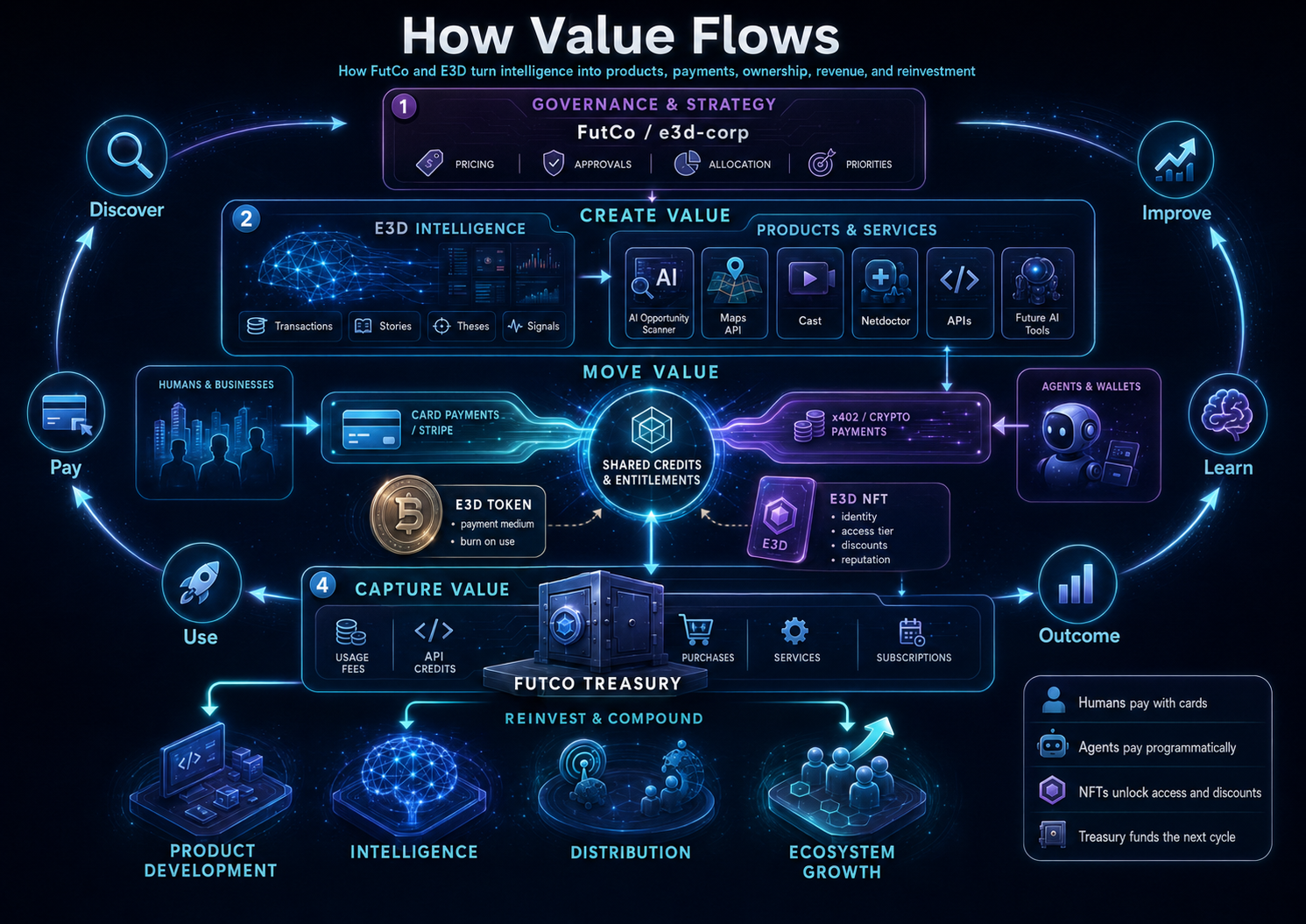
CREATION, MOVEMENT, CAPTURE, APPRECIATION
Before scoring any AI initiative, we sort what it actually produces into one of these four. Only one of them shows up in a bank account.
Something becomes more useful or more capable — a system gets faster, a model gets more accurate, a report gets sharper. Real, and often worth doing. Not, by itself, money.
An asset, a right, or a finished piece of work changes hands — a file gets delivered, a workflow hands off between systems, a customer receives what they asked for. Something moved. Check separately whether anyone actually paid for it.
The business receives something it can actually spend — a payment clears, a subscription renews, a fee gets collected. This is the only one of the four that shows up in a bank account.
Something's on-paper value goes up — a growing user base, a more capable product, a rising valuation. Real, sometimes very real. But it's optionality, not cash, until something else converts it.
BEFORE ANY OF THIS
Everything above assumes something worth paying for already reached someone willing to pay for it. That's not automatic. Distribution — content, outreach, product surfaces, referrals, free tools — is what connects something created to someone who might value it. Skip it, and creation just accumulates in a drawer.
THE SAME PATTERN, ZOOMED IN
This is the same loop behind every Audit and Sprint — business context leads to a governed decision, which a specialized system executes. The part most AI initiatives skip is the next step: naming, precisely, which of the four things the outcome actually was before deciding what to do with it.
WORKED EXAMPLE
Four outcomes from FutCo's own execution arms — same as the ones on How We Work, sorted honestly:
| What happened | Looks like | Actually is | Why it matters |
|---|---|---|---|
| A specialized system finishes a rendering job and the customer pays for it | Revenue | Capture | Cash lands in the business immediately, for a specific delivered product. This is the real one. |
| A paper-trading system's simulated portfolio gains value during a test window | A return | Appreciation of a test | No real capital is deployed yet. Nothing has been captured — only measured, on purpose, before anything real is risked. |
| An agentic build system ships a feature that makes the product more capable | Progress | Creation | The business is genuinely more capable afterward. Nothing has changed hands or been paid for — yet. |
| A finished asset is handed off to the party who requested it | Delivery | Movement (Capture only if payment happened in the same step) | Worth checking explicitly — delivery and payment are two separate events that are easy to report as one. |
Creation, movement, and appreciation aren't the problem — they usually set up the capture that follows. The mistake is reporting them as if they already were capture.
WHY THIS MATTERS TO YOU
Before we recommend scaling any AI initiative, we ask which of the four it's actually producing — and whether the plan to get from the first three to capture is real or assumed.
An AI Opportunity Audit doesn't just find where AI could help — it identifies where the result would be captured value, not just activity.